
Landing page banner



A string of letters and numbers may not look like much. But to a cryptocurrency investigator, this digital wallet address can be the first clue in a trail that reveals where stolen funds have gone – and potentially who is behind the crime.
Blockchain is a digital record book that securely tracks transactions. Unlike cash, cryptocurrency transactions on many blockchains are recorded on a publicly accessible ledger. The challenge lies in making sense of the trail. Criminals can move funds across multiple digital wallets, split them into smaller amounts or use privacy tools to make tracing more difficult.
For officers from the Singapore Police Force’s (SPF) Cyber Command, following this digital money trail takes technical expertise, investigative instincts and close collaboration with partners.
Two officers at the forefront of this work are Assistant Superintendent of Police (ASP) Mohamed Shariff Ahmed Munshi, a Cryptocurrency Tracing Officer with the Anti-Scam Centre’s Crypto Tracing Team, and Mr Muhammad Syazwan Bin Suhaimi, a Cyber Specialist (Cryptocurrency) with the Cybercrime Investigation Branch (CIB).
Though their roles differ, both share a common purpose: to track illicit funds, support investigations and protect people from further harm.
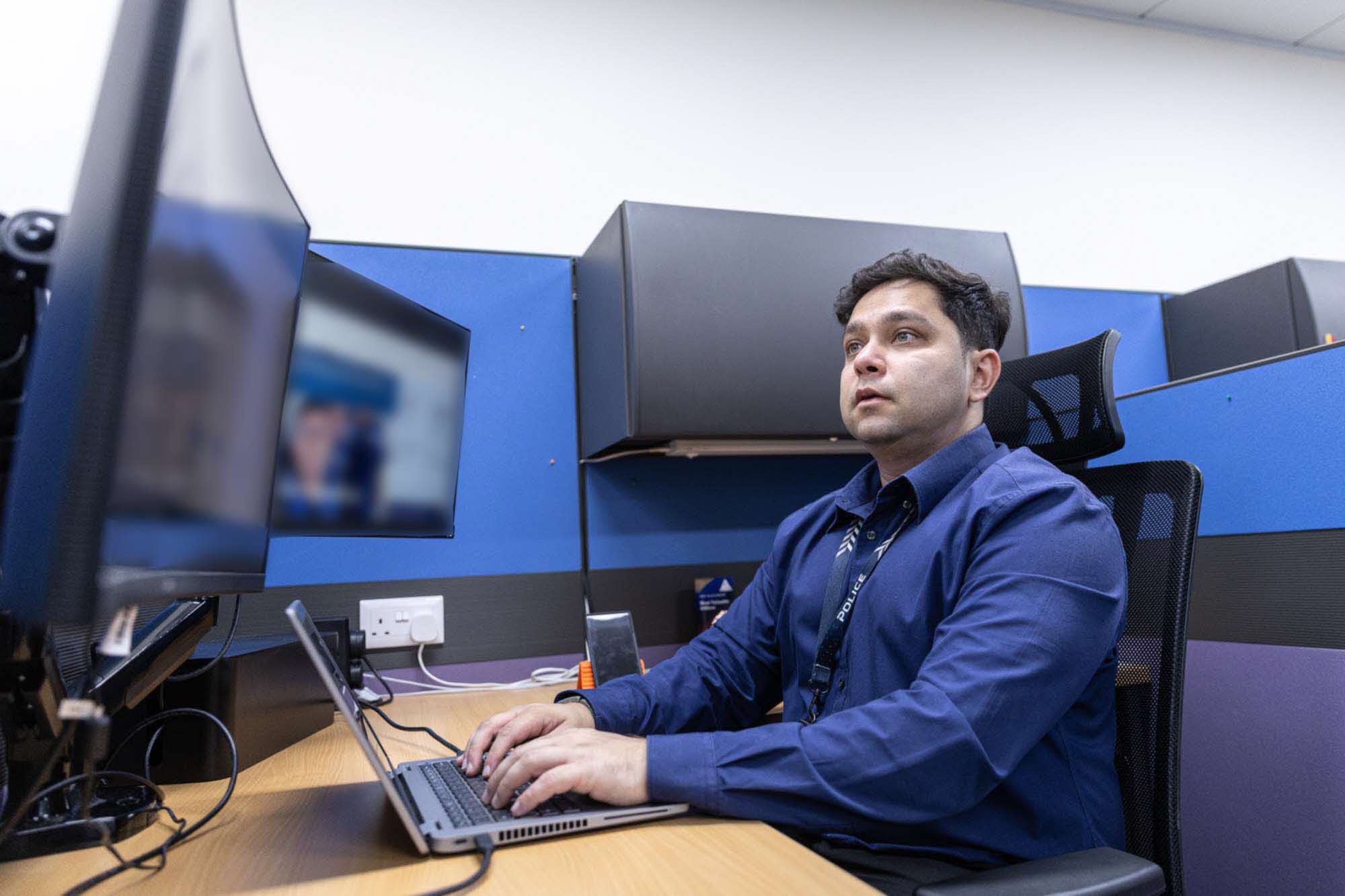
Turning Digital Traces into Investigative Leads
For ASP Shariff who has nine years of experience in the Force, the work begins when a scam victim makes a Police report. Investigators may start with just a digital wallet address or a transaction record showing where the victim’s cryptocurrency was sent.
Using blockchain analytics, his team follows fund movement across digital wallets and platforms, looking for leads that could help disrupt the flow or preserve funds before they become harder to recover. “Blockchain analysis turns a string of digital wallet addresses into a clear picture of how the money is moving,” he explained.
The findings can reveal that what appears to be an isolated scam, may in fact be connected to a wider digital crime network. This is where collaboration becomes crucial. ASP Shariff works with cryptocurrency exchanges, blockchain analytics firms, banks and overseas law enforcement agencies to trace funds and coordinate interventions across borders. “Blockchain is global by design, so our response must be global too,” he said.
But tracing the money is only part of the mission. His team also uses its findings to identify victims who may still be caught in ongoing scams. Some believe they’re making legitimate investments or helping someone they trust. By the time the Police reach them, they may have already transferred substantial funds and may be preparing to send more.

Through proactive operations with industry partners, Cyber Command uses blockchain analysis to identify potential victims and reach them before further fund transfers are made.
Between March and August 2026, four joint operations involving the Police, participating cryptocurrency exchanges and digital payment token service providers identified more than 720 potential scam victims and prevented more than $18.9 million in potential losses.
“Sometimes the best outcome is stopping another transaction from happening at all,” he said.
Even when the Police identify suspicious transactions, some victims remain convinced that the people they’re communicating with are genuine. In such situations, ASP Shariff and his team walk victims through the evidence, showing them how their money moved from one digital wallet to another.
“Investigations require not only the ability to uncover the truth,” he said. “It also takes patience and empathy to help victims understand it.”

Building Tools to Uncover Hidden Trails
While ASP Shariff focuses on tracing scam proceeds and enabling timely interventions, Mr Syazwan, applies his cybersecurity expertise to a broader range of cryptocurrency-linked cybercrime investigations.
Seconded from the Cyber Security Agency of Singapore in 2025, Mr Syazwan specialises in examining digital evidence and developing tools to support investigations.
“My work involves gathering open-source intelligence, examining evidence from systems and devices, and piecing together digital clues to identify the threat actors behind an attack,” he shared.
Specialised blockchain analytics platforms help investigators map digital wallet activity and follow cryptocurrency flows. But not every investigative challenge can be solved with existing tools. “Some of what we need for specific cases doesn’t exist off the shelf,” Mr Syazwan explained.
To address these gaps, he develops customised tools that help investigators analyse complex transactions and uncover techniques to conceal the movement of funds.
One case that stands out involved a cryptocurrency exchange hack worth around $8.8 million. Part of the stolen funds had been channelled through a privacy mixer – a service designed to scramble the money trail, making it harder to determine which funds belong to whom.
Using a tool he’d built specifically to analyse such activity, Mr Syazwan identified funds linked to the stolen proceeds, leading investigators directly to the accused.

Behind Every Digital Wallet Address
As cryptocurrency and technology continue to evolve, so do the methods used by criminals. Artificial intelligence, for instance, can make scams more convincing through polished messages, impersonation and fabricated audio or video.
To keep pace with these threats, Cyber Command officers must continue to strengthen their technical capabilities, develop new investigative methods and work closely with industry and overseas agencies.
But beyond the technology and investigative techniques, both officers are driven by the same thing: the people behind the digital transactions.
“Turning an apparently impossible trail into a meaningful lead and seeing the tools I develop help other officers work more efficiently gives me real satisfaction,” Mr Syazwan said.
For ASP Shariff, that satisfaction comes from reaching victims in time to prevent further losses. “Behind every digital wallet address is a real person,” he said. “That’s why we do this.”
Cyber Command Series
In this series, learn how Cyber Command officers work behind the scenes to keep Singapore safe from scams and cybercrime.
Check out:
- When Hackers Hit Home: Two Investigators Who Fight High-Stakes Cybercrime


