
Landing page banner


A woman transferred her life savings into a suspected money mule account, unaware that she was being scammed. In another case, a woman suspected of acting as a scam mule turned out to have been a scam victim herself.
These were two encounters that left a lasting impression on Deputy Superintendent of Police (DSP) Timothy Ng and Inspector (Insp) Harbhajan Kaur.
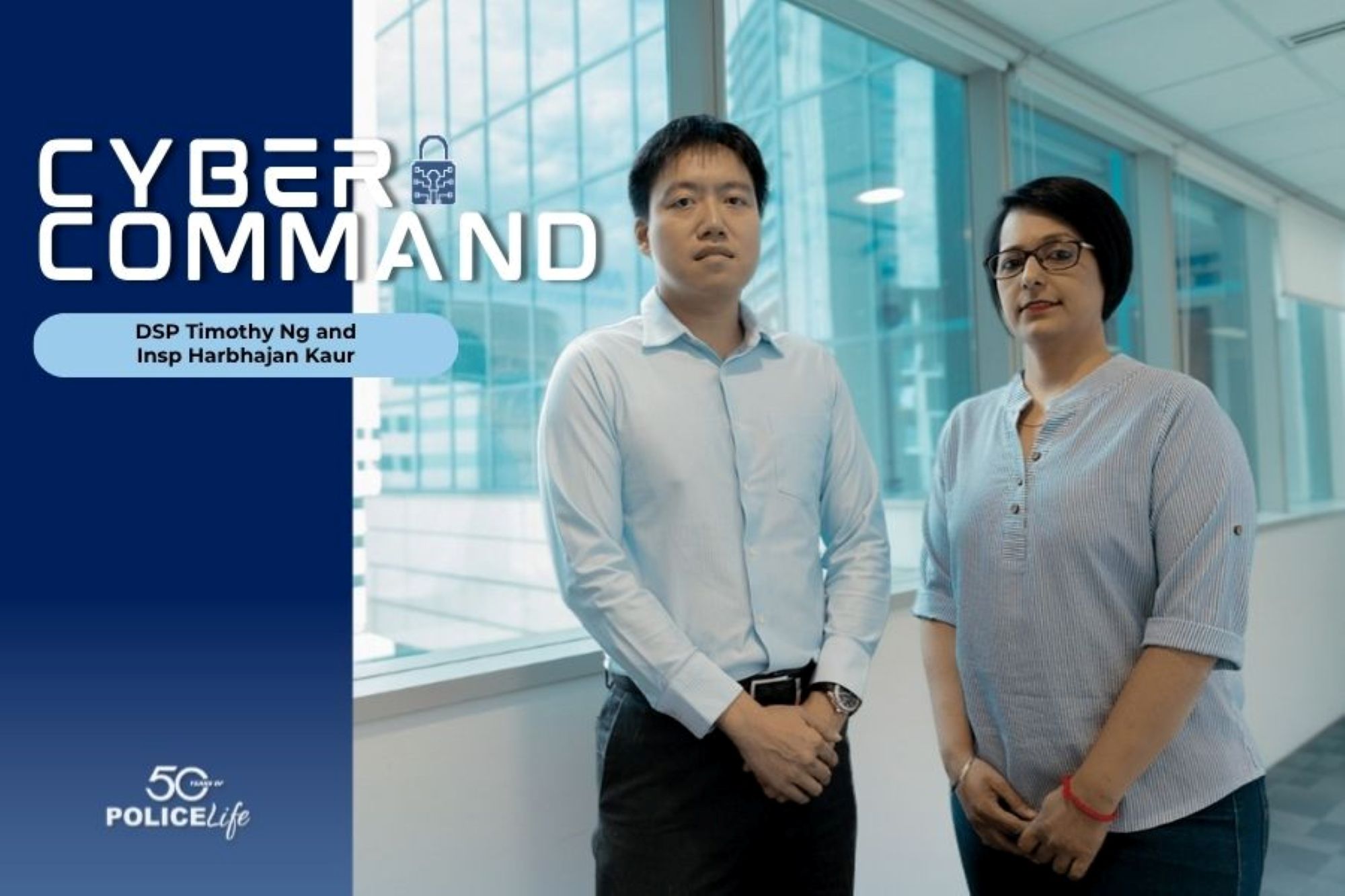
At the Singapore Police Force’s (SPF) Cyber Command, the two officers tackle scams in different ways. While DSP Timothy works to stop ongoing scams and prevent further financial losses, Insp Harbhajan investigates cases to uncover those responsible. Their experiences offer a glimpse into the work behind the scenes in the fight against scams.
Racing Against Time
At the Anti-Scam Centre (ASC), DSP Timothy and his team face a constant challenge – stopping scammers before more money is lost.

Having served in the SPF for 12 years, DSP Timothy’s interest in combatting scams grew during a posting at the Criminal Investigation Department, where he supported a workgroup tackling the rising scam threat. This led him to join the ASC in 2022.
Today, as an Officer-in-Charge, he leads a team that traces and seizes scam proceeds, freezes money mule accounts and intervenes to protect victims. With scammers moving funds quickly between accounts, officers often have little time to act.
DSP Timothy recalled an incident where a bank alerted the ASC after detecting funds being transferred into a suspected money mule account. He contacted the woman who had made the transfer, only to realise she was unaware she’d been scammed.
After speaking with her, he convinced her to lodge a Police report, allowing officers to seize the funds. What struck him most was the woman’s gratitude, as the money represented her entire life savings.
“It was a poignant reminder of the impact our work has on people’s lives,” he shared.
Not every intervention goes as smoothly. Some victims have been manipulated into distrusting the Police, and officers may need to engage them several times before these victims acknowledge the deception.

The reality that anyone can fall victim to scams became personal when one of DSP Timothy’s family members was targeted by a Government Official Impersonation Scam (GOIS). Sensing something was wrong, he stepped in midway through a call with the scammer, which had already lasted at least an hour. Thankfully, no money was lost, although some personal and financial information had been disclosed.
“It made me acutely aware that even someone who’s well-educated and usually cautious of scams can be vulnerable,” he reflected.
Looking Beyond the Surface
While DSP Timothy focuses on preventing further losses, Insp Harbhajan follows investigative leads to uncover those behind scam activities.

Her interest in scam investigations grew during a posting with Clementi Police Division’s Scam Strike Team, leading her to join the then-Anti-Scam Command in 2025. Now a Senior Investigation Officer at the Anti-Scam Investigation Branch (ASIB), she investigates scam cases, traces illicit funds and works with local and international partners to uncover criminal networks.
After 28 years with the SPF, she’s learnt that there’s often more to a case than meets the eye.
One case has stayed with her. While interviewing a woman suspected of acting as a scam mule, Insp Harbhajan noticed subtle cues in her body language that suggested she might be withholding information.
She probed further and spoke separately with the woman’s mother. Through these conversations, she discovered the woman had first been a scam victim before being manipulated and coerced into acting as a scam mule.

The discovery allowed her to assess the woman’s circumstances more fully, rather than viewing her solely as a suspected offender.
“Individuals who appear to be offenders may themselves be victims of exploitation or deception,” Insp Harbhajan shared. “Behind every case file is a person with a story.”
Her work also involves disrupting the resources that criminal syndicates rely on.
An island-wide enforcement operation from 20 April to 8 May 2026 targeted the fraudulent registration of Subscriber Identity Module (SIM) cards. Investigations revealed that individuals were paid between $10 and $20 per SIM card to register and purchase them in bulk, before handing over 30 to 64 cards to criminal syndicates.
These SIM cards were subsequently used to facilitate scams, illegal moneylending and vice activities. The operation resulted in seven arrests, while another 65 individuals were placed under investigation.
“By disrupting the supply of fraudulently registered SIM cards, we cut off a key resource that syndicates rely on to carry out their operations and evade detection,” Insp Harbhajan explained.
Stronger Together Against Scams
Although DSP Timothy and Insp Harbhajan have different responsibilities, their work is closely connected. Since the Cyber Command was established on 3 July 2026, key intelligence, investigation and operational functions have been brought together under one roof.
Insp Harbhajan shared that this has made it easier to exchange information and tap on colleagues’ expertise. DSP Timothy also noted that closer coordination has helped officers respond more effectively, from detecting potential scams to alerting victims and disrupting criminal activities.
Beyond their operational roles, both officers find meaning in knowing that their work makes a difference in people’s lives.
“There’s great satisfaction in helping victims of GOIS realise that the scammers’ threats aren’t real,” DSP Timothy shared.
“Beyond enforcement, my work is about ensuring that victims are heard, those who are exploited are treated fairly and the people behind these crimes are held accountable,” Insp Harbhajan said.
Cyber Command Series
In this series, learn how Cyber Command officers work behind the scenes to keep Singapore safe from scams and cybercrime.
Check out:
- When Hackers Hit Home: Two Investigators Who Fight High-Stakes Cybercrime
- Beyond the Blockchain: Two Officers Tracing Cryptocurrency Crime
- On the Digital Frontline: Two Officers Disrupting Cybercrime


