
Landing page banner


The Traffic Police (TP) will tighten the demerit points regime, also known as the Driver Improvement Points System (DIPS), for Singapore Driving Licence holders from 1 January 2027.
Road safety has deteriorated. The number of road fatalities increased by 5%, from 142 deaths in 2024 to 149 in 2025, reaching a 10-year high. The number of injured persons also increased by 6.6%, from 9,342 in 2024 to 9,955 in 2025.
The tightening of DIPS is intended to deter traffic violations and keep errant motorists off the roads for longer periods, and to complement the legislative changes enabling stronger enforcement against traffic offences tabled in Parliament recently by MHA.
Changes to the DIPS for Non-Probationary Motorists
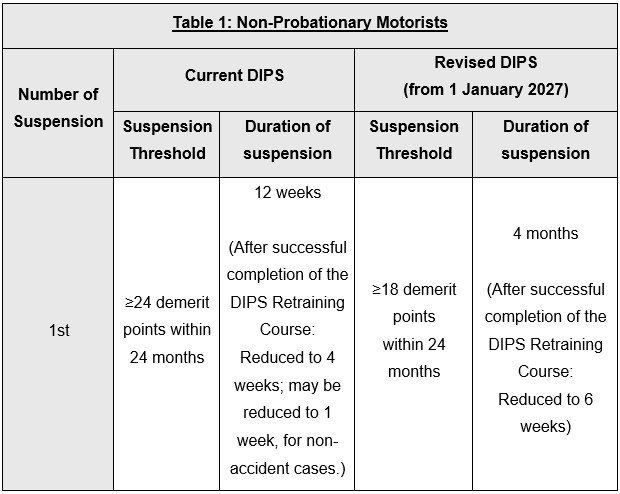
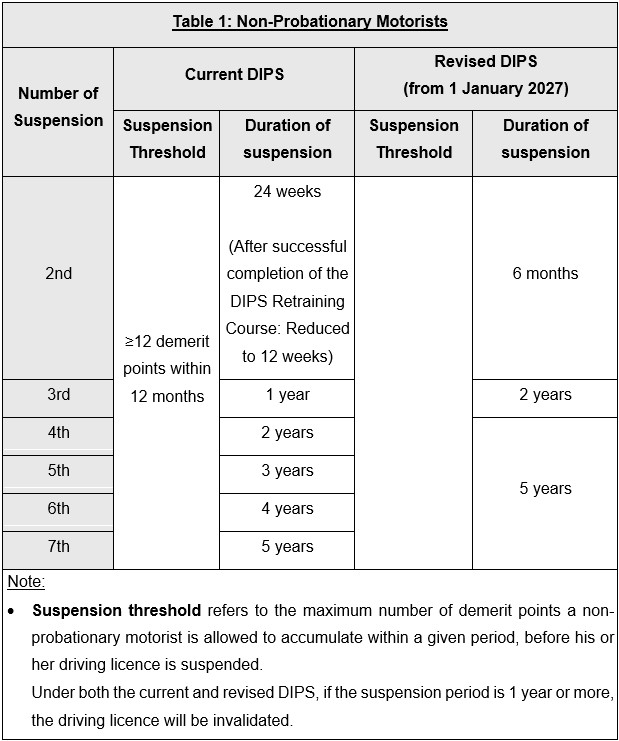
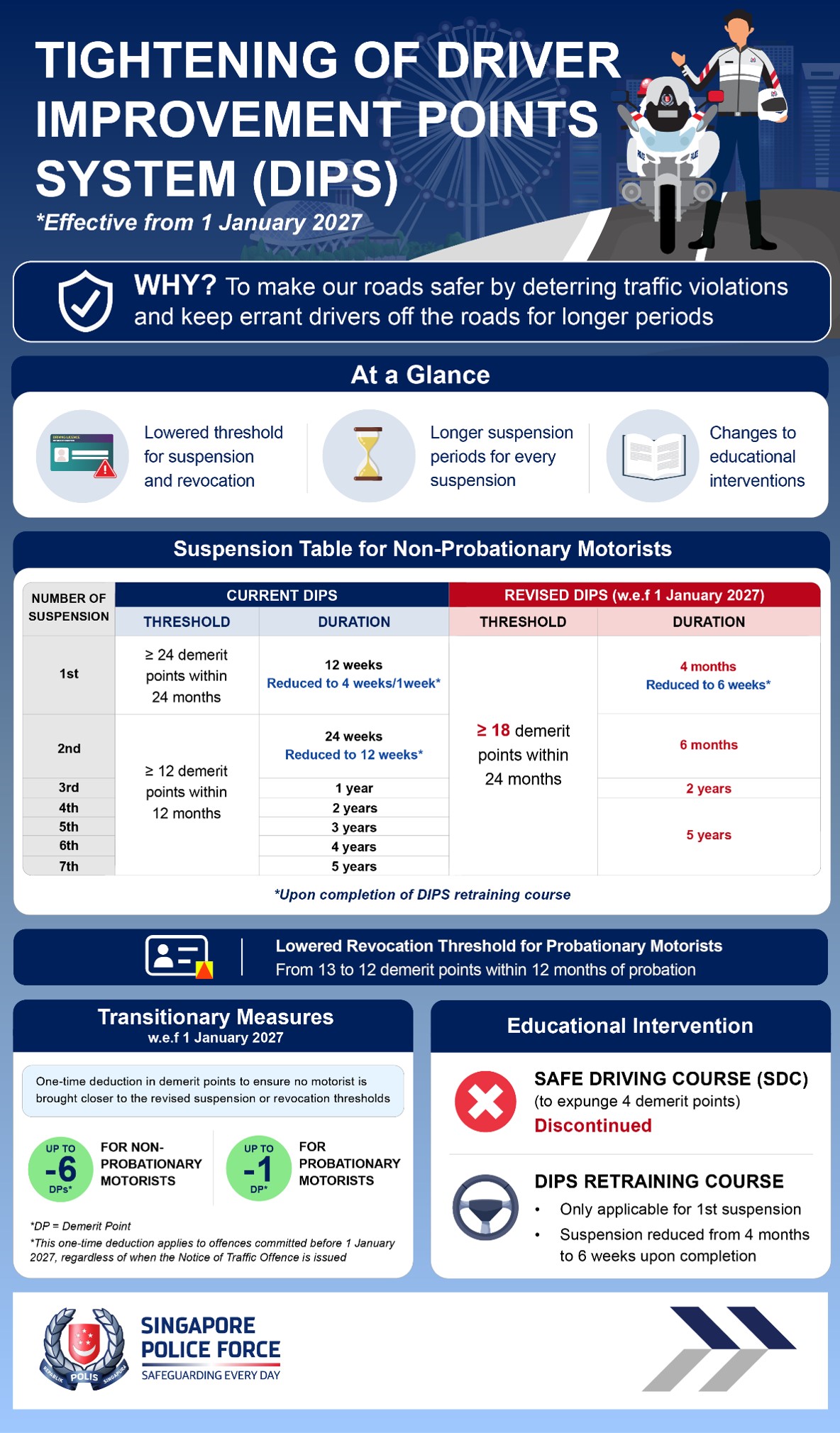
Non-probationary motorists (i.e. motorists who have completed their one-year probationary period) will be subject to three key changes under the revised DIPS. Table 1 sets out the detailed comparison between the current and revised DIPS.
1) Lowered threshold for the first suspension
Under the revised DIPS, non-probationary motorists will be suspended once they accumulate 18 demerit points within 24 months, instead of the current 24 demerit points.
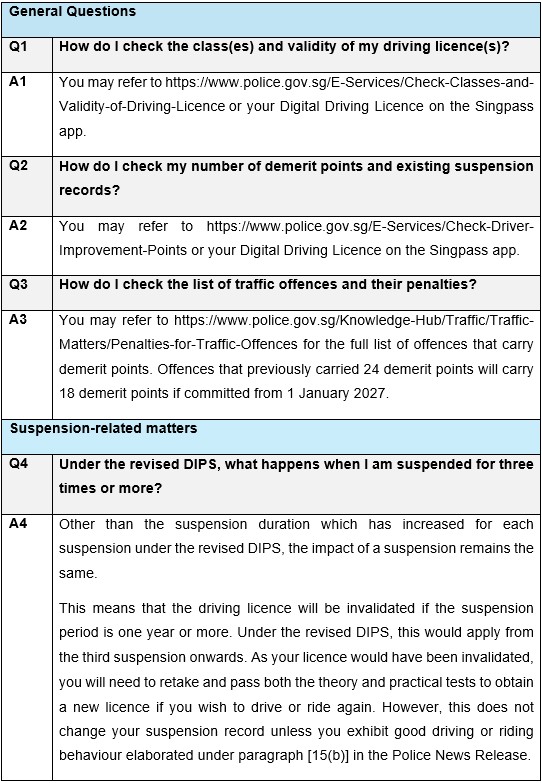
With the revised suspension threshold, there is no practical need to award more than 18 demerit points for any offence. Accordingly, offences that currently carry 24 demerit points will be revised to 18 demerit points. These offences are:
- Exceeding the vehicular speed limit by more than 50 km/hr;
- Exceeding the road speed limit by more than 50km/hr; and
- Reckless or dangerous driving.
2) Longer suspension periods for every suspension
There is currently a tiered suspension regime, where a driver’s first suspension is shorter than subsequent suspensions, which also become longer progressively. As part of the tightening of the DIPS regime, the first suspension period will increase from 12 weeks to four months. The suspension periods for subsequent suspensions will also increase.
3) Changes to educational interventions
Under the current DIPS, there are two educational interventions to improve motorists’ driving mindset and behaviour: the DIPS Retraining Course and the Safe Driving Course (SDC).
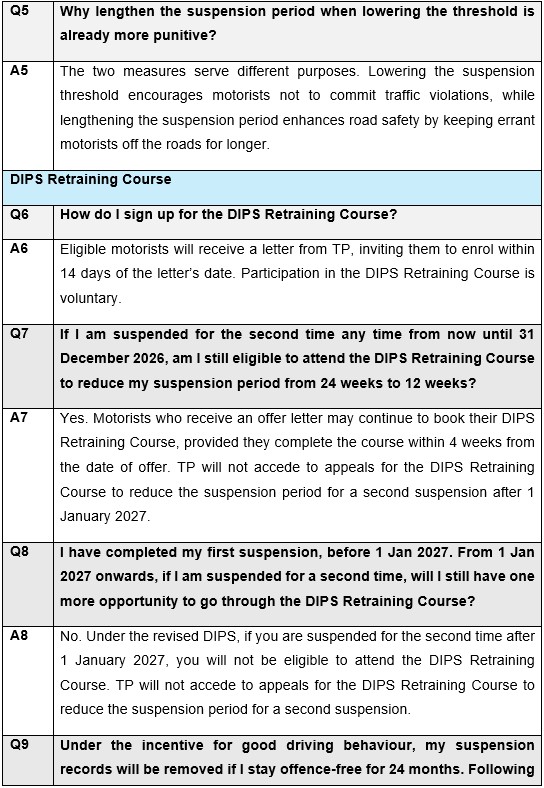
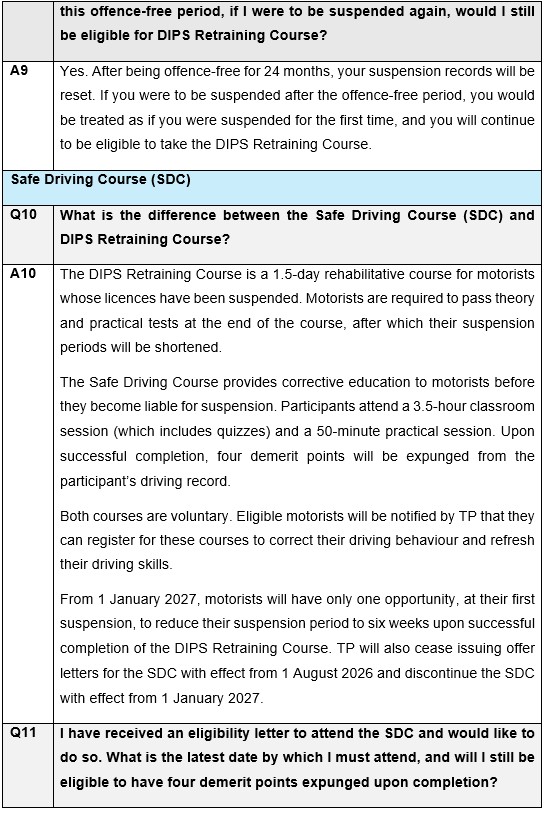
The DIPS Retraining Course is a 1.5-day rehabilitative programme for motorists who are suspended. Motorists who complete this course will have their suspension periods reduced. From 1 January 2027, motorists will have only one opportunity at the first suspension to reduce their suspension period from four months to six weeks upon completion of the course. The reduced suspension period would still be longer than under the current DIPS, where those who complete the course face suspension periods of either one or four weeks (depending on whether they were involved in an accident). The DIPS Retraining Course and the accompanying reduction in suspension period will not be available for motorists’ second and subsequent suspensions. Motorists who persistently pose a risk to road safety will face progressively longer suspension periods to keep them off our roads.
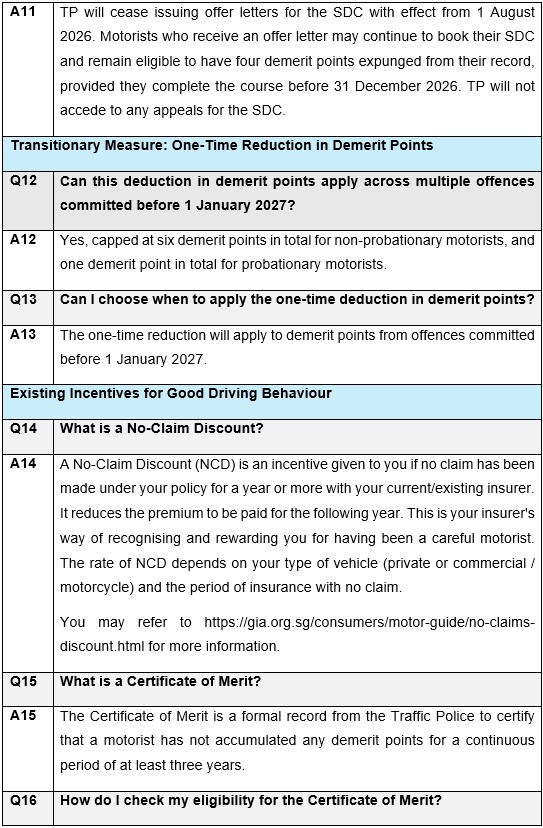
The SDC is an early corrective course lasting 4 hours and 20 mins, for eligible motorists who have incurred demerit points but have not yet reached the suspension threshold. Currently, motorists who complete this course will have four demerit points expunged from their driving records. A review of data from 2023 to 2025 showed that the take-up rate of SDC has been low, and only 15% of those who were offered the SDC last year had taken it up. Its impact on improving driving behaviour is also minimal, considering that the difference in re-offending rates between SDC and non-SDC takers is marginal. Hence, TP will cease offer letters for the SDC with effect from 1 August 2026 and discontinue the SDC with effect from 1 January 2027. Motorists who have received offer letters for the SDC must complete it by 31 December 2026.
Lowered Revocation Threshold for Probationary Motorists
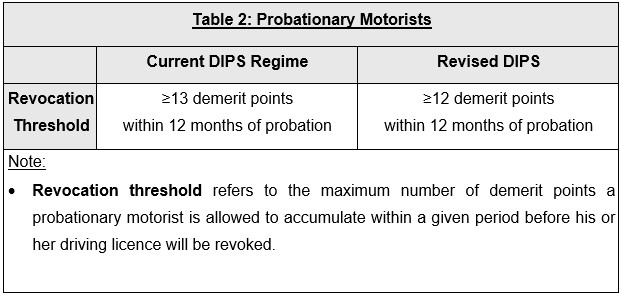
Probationary motorists are new licence holders who are under a one-year probation period from the date their driving licence is issued. From 1 January 2027, probationary motorists will have their licence revoked if they accumulate 12 demerit points during the probation period, instead of 13 demerit points under the current DIPS, as outlined in Table 2 below. This will help shape responsible driving behaviour at an early stage for new motorists.
Transitionary Measures – One-Time Adjustment of Demerit Points
To ensure that no motorist is brought closer to the revised suspension or revocation thresholds due to the changes in the DIPS, there will be a one-time adjustment of demerit points for all motorists on 1 January 2027. For non-probationary and probationary motorists, up to six demerit points and one demerit point respectively will be deducted from their total demerit points (if any) as of 31 December 2026.
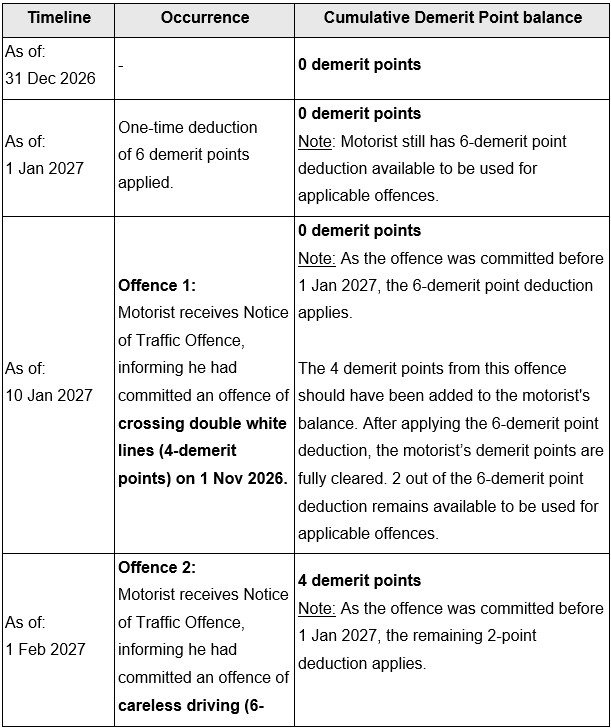
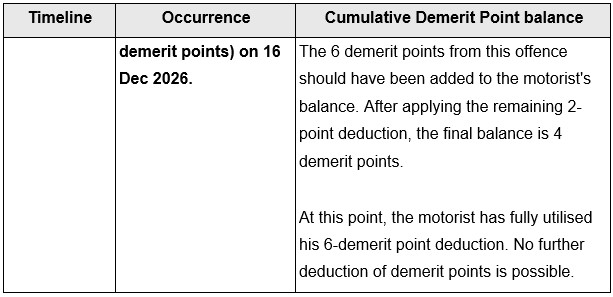
Where a motorist's demerit point balance is lower than the amount to be deducted, their demerit point balance will be set to zero, and the remaining points deduction will be applied to any offences committed before 1 January 2027, regardless of when the Notice of Traffic Offence is issued.1 This will not apply for offences committed on or after 1 January 2027.
The composition sums for the relevant offences remain payable and are unaffected by this adjustment.
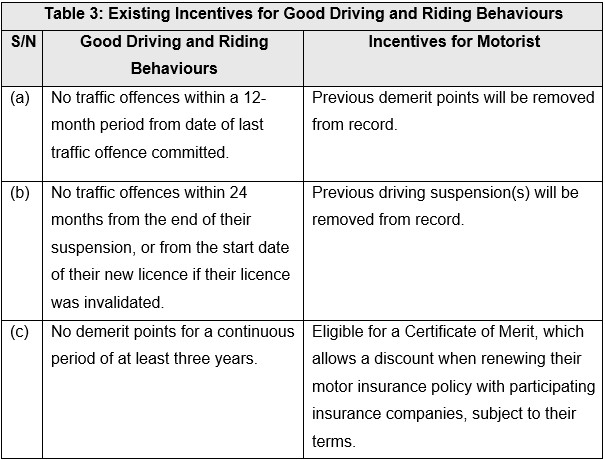
Retention of Incentives for Good Driving and Riding Behaviour
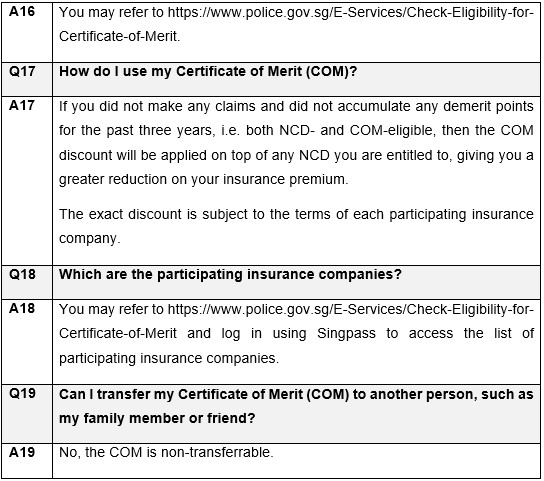
The following incentives for good driving and riding behaviour remain unchanged:
Second Minister for Foreign Affairs and Second Minister for Home Affairs Sim Ann said, “With road fatalities reaching a 10-year high, it is clear that we must do more to improve road safety. We hope that the revised DIPS, which lowers the threshold for suspension and revocation, will further deter motorists from unsafe driving. In revising DIPS, we were mindful of vocational drivers’ potential concerns about the impact on their livelihoods, and consulted transport union leaders. Arising from their feedback, we have decided to provide for a one-time deduction of demerit points, to ensure that motorists are not subject to suspension or revocation simply as a result of the new rules coming into effect. We urge every motorist to reset their driving habits and mindset ahead of the new DIPS coming into effect on 1 Jan 2027, and also urge all road users – not just motorists – to obey traffic rules for everyone’s safety and well-being.”
The Police will continue to enhance road safety for all road users – not only motorists – through effective enforcement and public education.
1This means that the remaining points can be used on offences committed before 1 January 2027, for instance on 31 December 2026, even if the Notice of Traffic Offence is issued after 1 January 2027. Annex A shows three illustrations of how the one-time adjustment of demerit points will apply.
ANNEX A
Illustration 1 – For non-probationary motorists with 6 or more demerit points
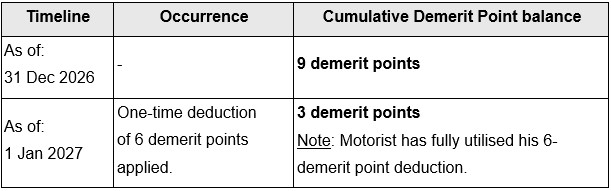
Illustration 2 – For non-probationary motorists with less than 6 demerit points
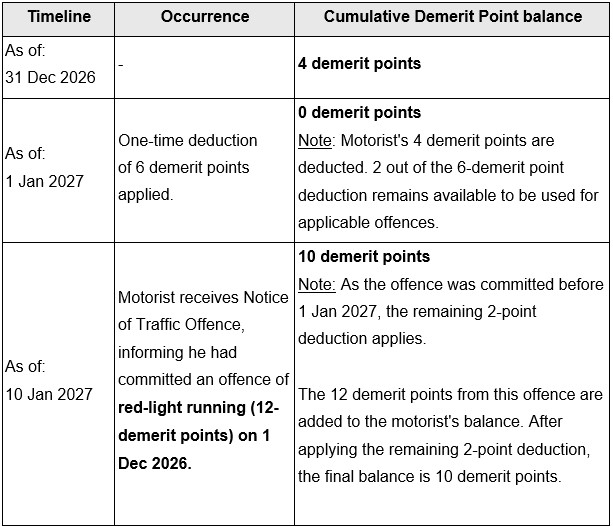
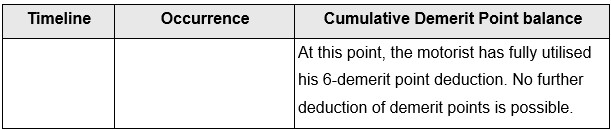
Illustration 3 – For non-probationary motorists with 0 demerit points
ANNEX B
FREQUENTLY ASKED QUESTIONS (FAQs)
PUBLIC AFFAIRS DEPARTMENT
SINGAPORE POLICE FORCE
31 July 2026 @ 2:00 PM