
Landing page banner


Singapore’s fight against organised crime stretches back decades. The original Organised Crime Branch (OCB), established in 1970 to tackle serious crimes such as firearms and robberies, was dissolved in 2002 as such offences declined following years of enforcement measures. However, globalisation and technological advances soon created new challenges – sophisticated criminal networks operating across borders and exploiting Singapore's status as a financial hub.
Recognising this evolving landscape, the Government passed the Organised Crime Act in 2015 and re-established the OCB alongside the Financial Investigation Branch (FIB). This strategic pairing combines investigative expertise with financial investigation capabilities to dismantle Organised Criminal Groups (OCGs) and deprive them of their criminal proceeds.
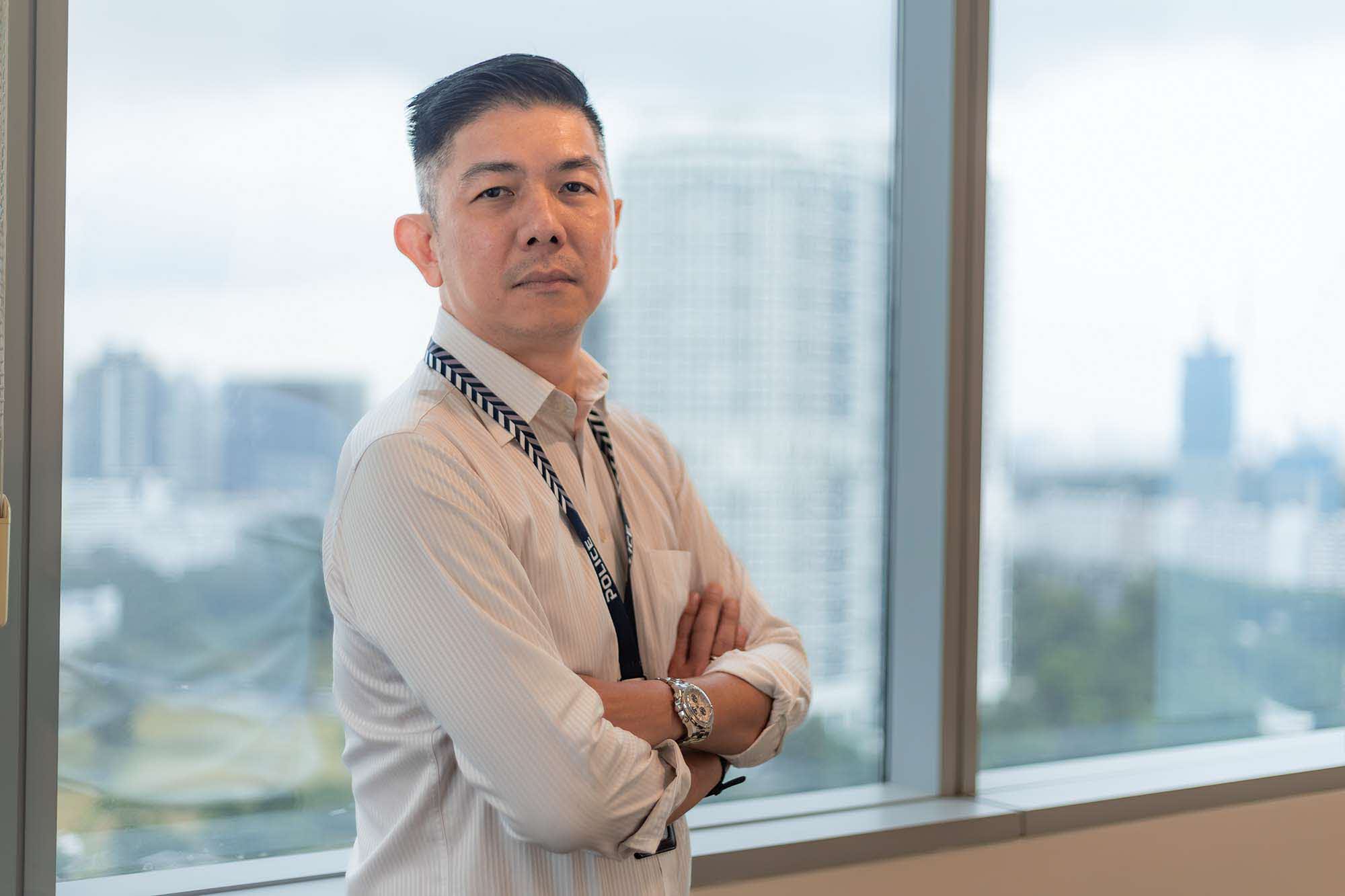
Ten years on, this partnership has proven instrumental in Singapore’s fight against organised crime. Behind its successes are dedicated officers like Deputy Superintendent of Police (DSP) William Tay, whose career exemplifies the commitment required to take on organised criminal networks.

Inside the Interview Room
“Actually, where I’m sitting right now is usually where the accused sits during interviews,” DSP Tay said with a laugh. We were seated in an interview room in the OCB office at the Police Cantonment Complex. Through the windows, I could see the cityscape of Chinatown: office buildings, shophouses and hotels alike.
“Do you mainly conduct interviews as part of your work as a Senior Investigation Officer (SIO)?” I asked.
“It’s more than just conducting interviews,” he replied. “My focus is on investigating OCGs, which are structured, hierarchical and primarily motivated by financial gain.”
OCB officers probe a range of syndicated activities, including how they operate, recruit members and carry out their illegal activities. “We conduct investigations against OCGs and deprive them of their criminal proceeds,” DSP Tay continued.
The OCB focuses on predicate offences – referring to the underlying crime that forms the foundation for a larger, more complex criminal enterprises to function. Examples of predicate offences include illegal gambling and other serious crimes.
“While the OCB handles the predicate offences, the FIB traces the funds of these syndicates,” he says. In his own words, the OCB and FIB work “hand-in-hand like a big family”.

The Shell Oil Heist Case
We moved on to the topic of his most memorable case – the 2018 Shell oil heist, a landmark case for the OCB. It involved the siphoning of hundreds of millions of dollars’ worth of marine fuel from Shell’s Pulau Bukom refinery over several years.
“The case was truly a test of my abilities,” DSP Tay recalled. To understand the marine fuel industry, he had to familiarise himself with the oil bunkering trade, the roles of the people working on bunkering vessels and standard maritime practices.
His task was simple in description, yet formidable in execution due to the scale of the enforcement required: to seize an entire chemical oil tanker as a case exhibit. This involved determining where to berth the tanker, how to maintain it and familiarising himself with all the relevant regulations on tankers.
He recalled: “Truthfully, I had no idea what to do. We’d never had to seize a chemical oil tanker before, and I had to quickly learn what a tanker is, its value, purpose and how to ensure its seaworthiness once it was taken as evidence.”
The enforcement operation eventually proceeded smoothly. The offenders received a range of sentences, and the tanker was also auctioned off because of DSP Tay and his team’s efforts.
He credits the communication between him and his colleagues as pivotal to the investigation. “In our team, there are no passengers, only drivers,” he said. “Every investigation is a team effort, and we help each other when needed.”

Three Decades in Blue
The inspiration to join the Singapore Police Force (SPF) first struck DSP Tay when he chanced upon a Police roadshow right after he’d completed his O-Levels.
In the blink of an eye, 30 years in the Force have gone by. DSP Tay’s career has spanned postings as a Ground Response Force officer, at the Casino Crime Branch of the Criminal Investigation Department, and now, the OCB, which he joined in 2016.
What’s the one thing he’s learnt from balancing a fulfilling career with personal life? “We need to learn the importance of time management,” he replied.
An avid fan of the Chelsea football club, he enjoys spending his weekends watching matches with his son and exercising with his family.
“I do sports four to five times a week,” he shared. “I’m proud to consistently obtain Silver for my Individual Physical Proficiency Test!”

The Road Ahead
As we close off our conversation, DSP Tay reflected on how OCGs continue to evolve. “These groups are getting more tech-savvy, using artificial intelligence tools to conduct offences.” With syndicates operating across borders and in cyberspace, detection has also become increasingly challenging.
To stay ahead, OCB officers continuously upskill themselves through courses on new technologies and crime trends. As the OCB and FIB mark their 10th anniversary, DSP Tay noted the OCB’s growth and successes over the past decade. “We’ve built a name through our cases and results,” he said.
Even as organised crime becomes more sophisticated, the OCB’s commitment remains unchanged: no passengers in their fight against criminal syndicates – only drivers safeguarding Singapore’s safety and security.
The OCB and FIB’s 10th Anniversary
This year marks a significant milestone for the Organised Crime Branch (OCB) and Financial Investigation Branch (FIB) as they celebrate their 10th anniversary. Police Life spotlights officers from both branches, offering readers an inside look at the vital work OCB and FIB officers conduct daily in their fight against sophisticated criminal networks and financial crimes.
Read the stories in our anniversary series – Deputy Assistant Commissioner of Police Eugene Wang and DSP Wong Ken Jon!


