
Landing page banner


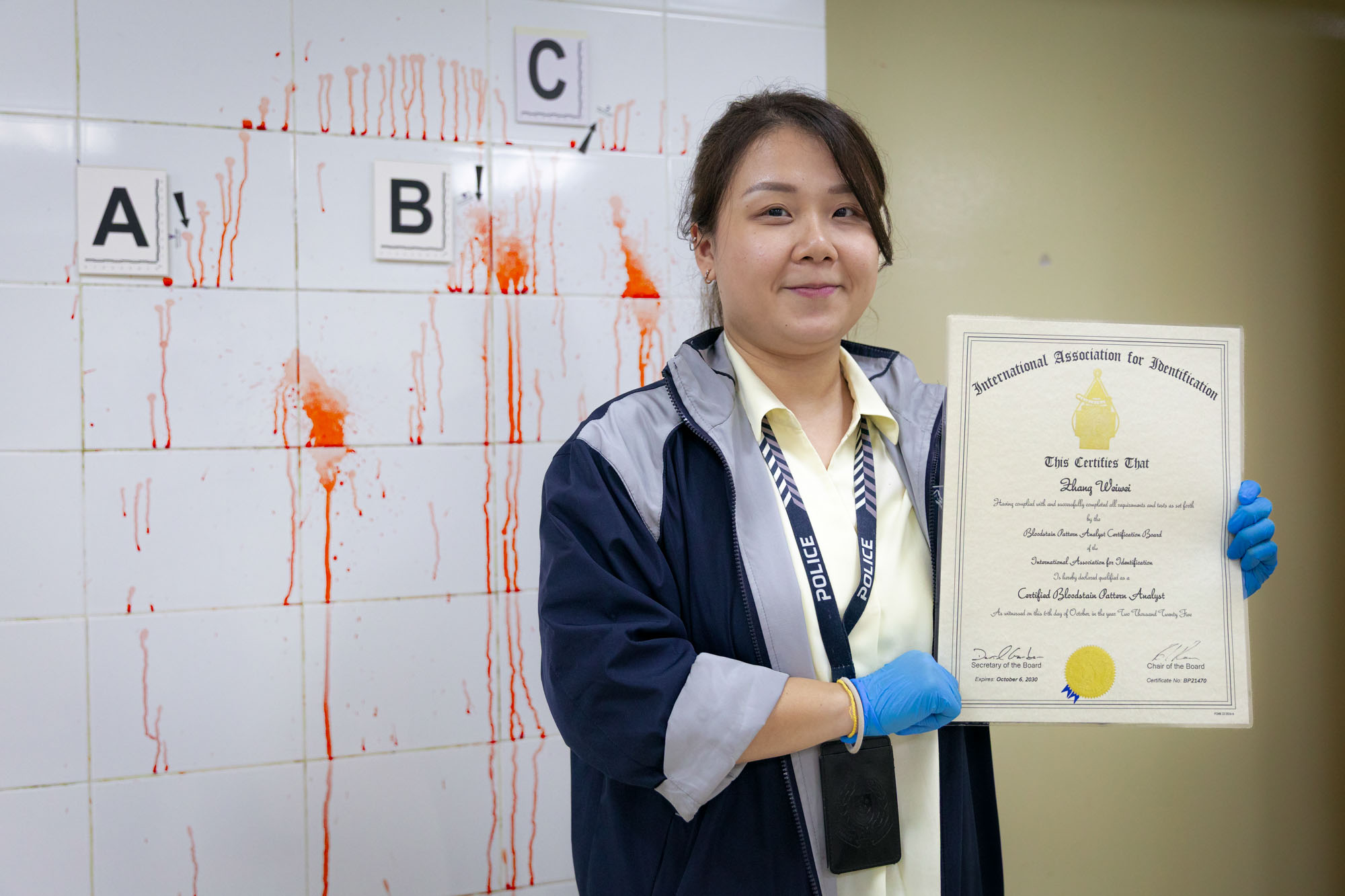
Dressed in a pastel yellow shirt with her hair bunched up in a loose ponytail, Ms Zhang Weiwei cheerily greeted me on the second floor of the Police Cantonment Complex, ready to introduce me to her work in forensic science.
Her optimistic demeanour and bright attire contrasted with the crime scenes she deals with in the course of her duties – the bodies of victims, bloodied clothes and trash from rubbish bins, all of which could be vital evidence for solving criminal cases.
Forward deployed from Home Team Science and Technology Agency, Weiwei is a Senior Crime Scene Specialist with over a decade of experience in the Forensics Division, under the Singapore Police Force’s (SPF) Criminal Investigation Department.
Working 12-hour shifts as a member of the Major Crime Squad, she collects and analyses evidence at crime scenes before passing it on for further documentation and examination.
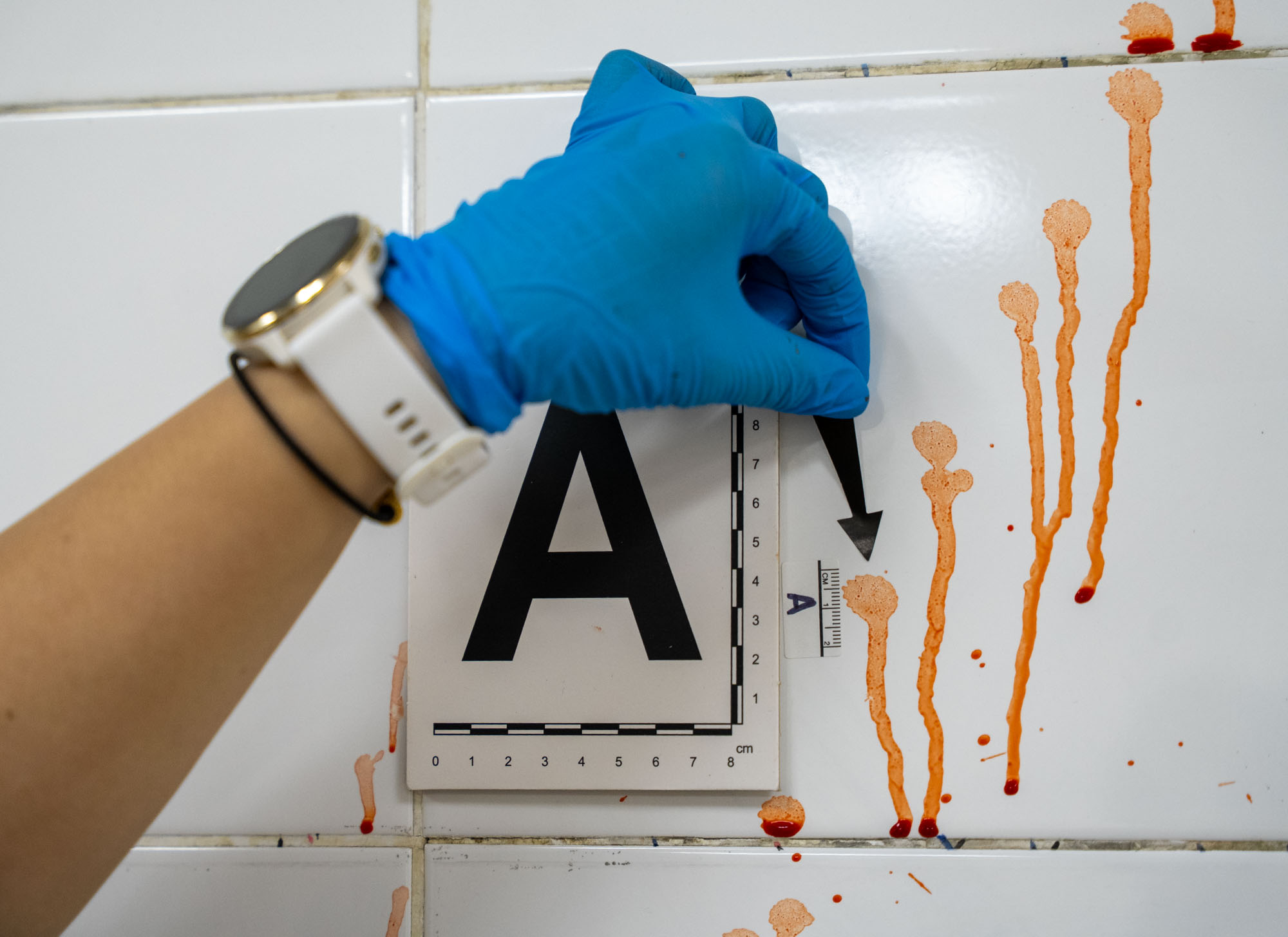
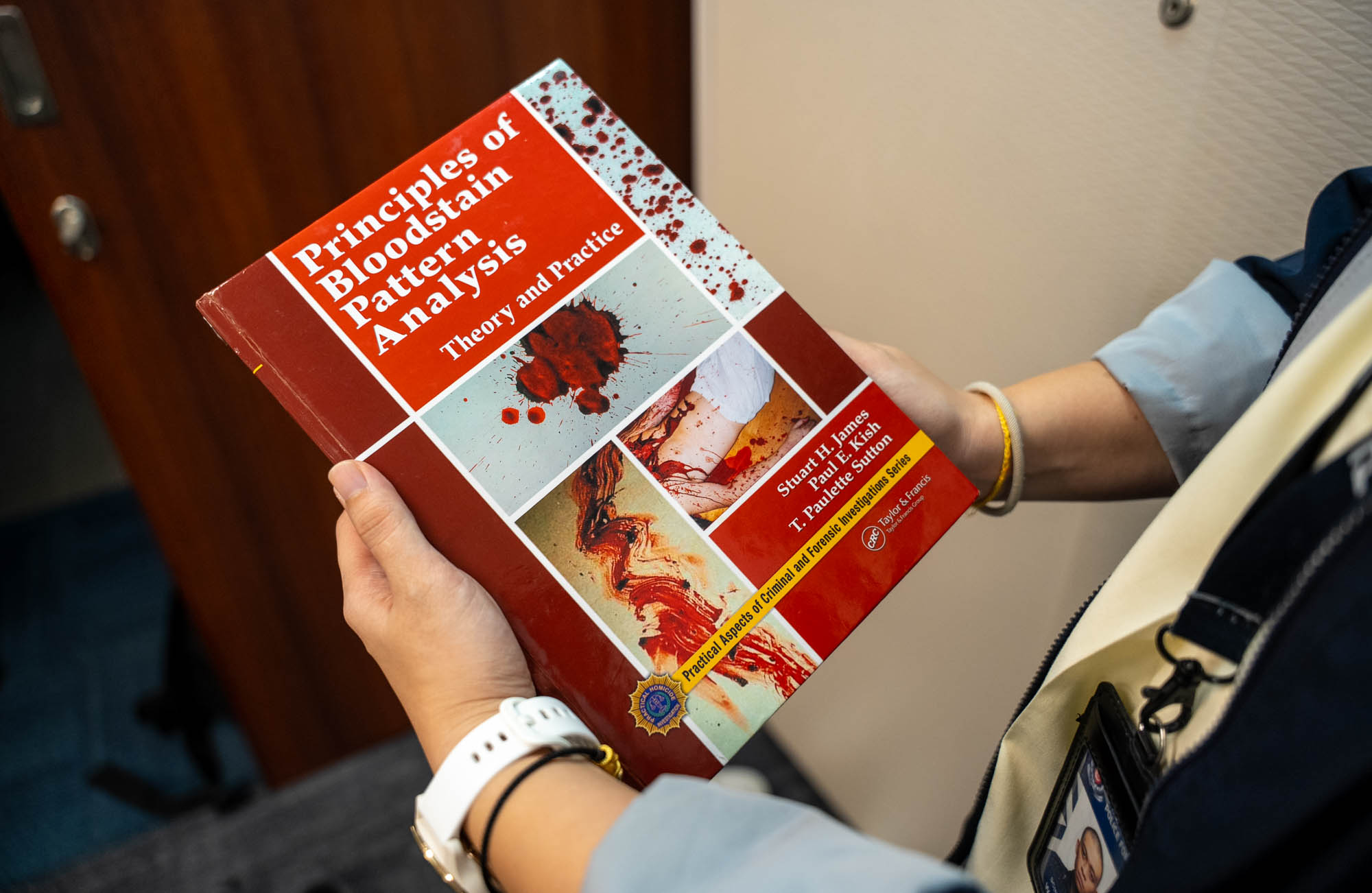
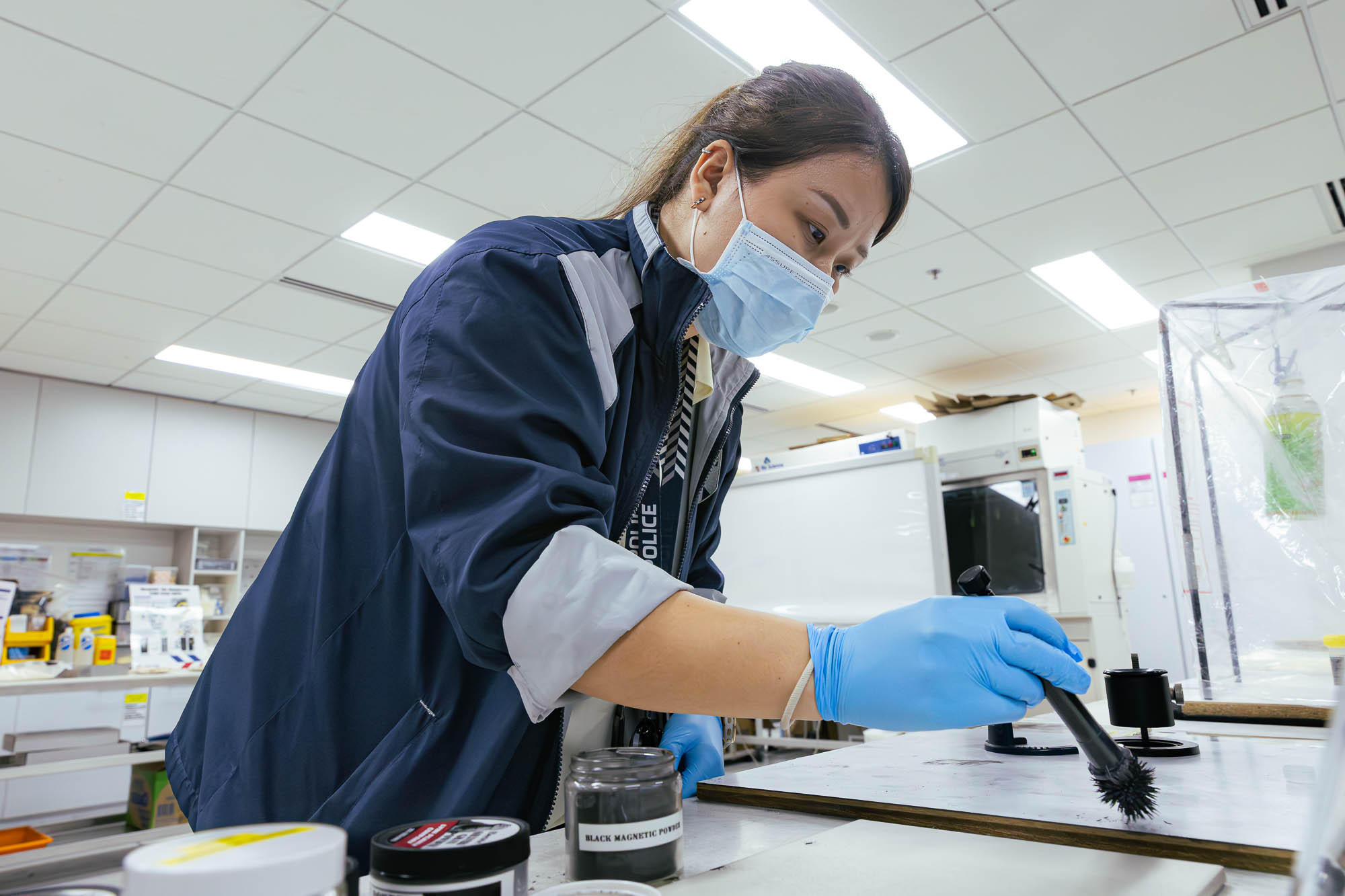
Weiwei carried out a few demonstrations while showing me around her workspace, squirting blood on the walls of one of the training rooms, dusting for fingerprints with a magnetic applicator and introducing a collection of forensic science titles. She kept her hands steady and maintained a calm composure throughout – a sure sign of her experience.
At 32, this has been her dream job since she was 14.“I didn’t see myself as a desk-bound kind of person,” said Weiwei. “I like to walk around and have new challenges every day. This job gives me that.”
Reading the Red
In October 2025, Weiwei became one of only two individuals in the Asia-Pacific certified to conduct Bloodstain Pattern Analysis (BPA) by the International Association of Identification, the global forensics institution.
She’s trained to examine different types of bloodstains and bloodstain patterns. This allows her to provide crucial insights for investigators.
“We analyse each bloodstain to determine what kind of stain it is. Piecing the stains together gives us an overall bigger picture of a crime scene,” she said. “Then we classify what type of mechanism could have caused the stain to appear this way. From there, we interpret the mechanism to support or refute testimonies given by the parties involved.”
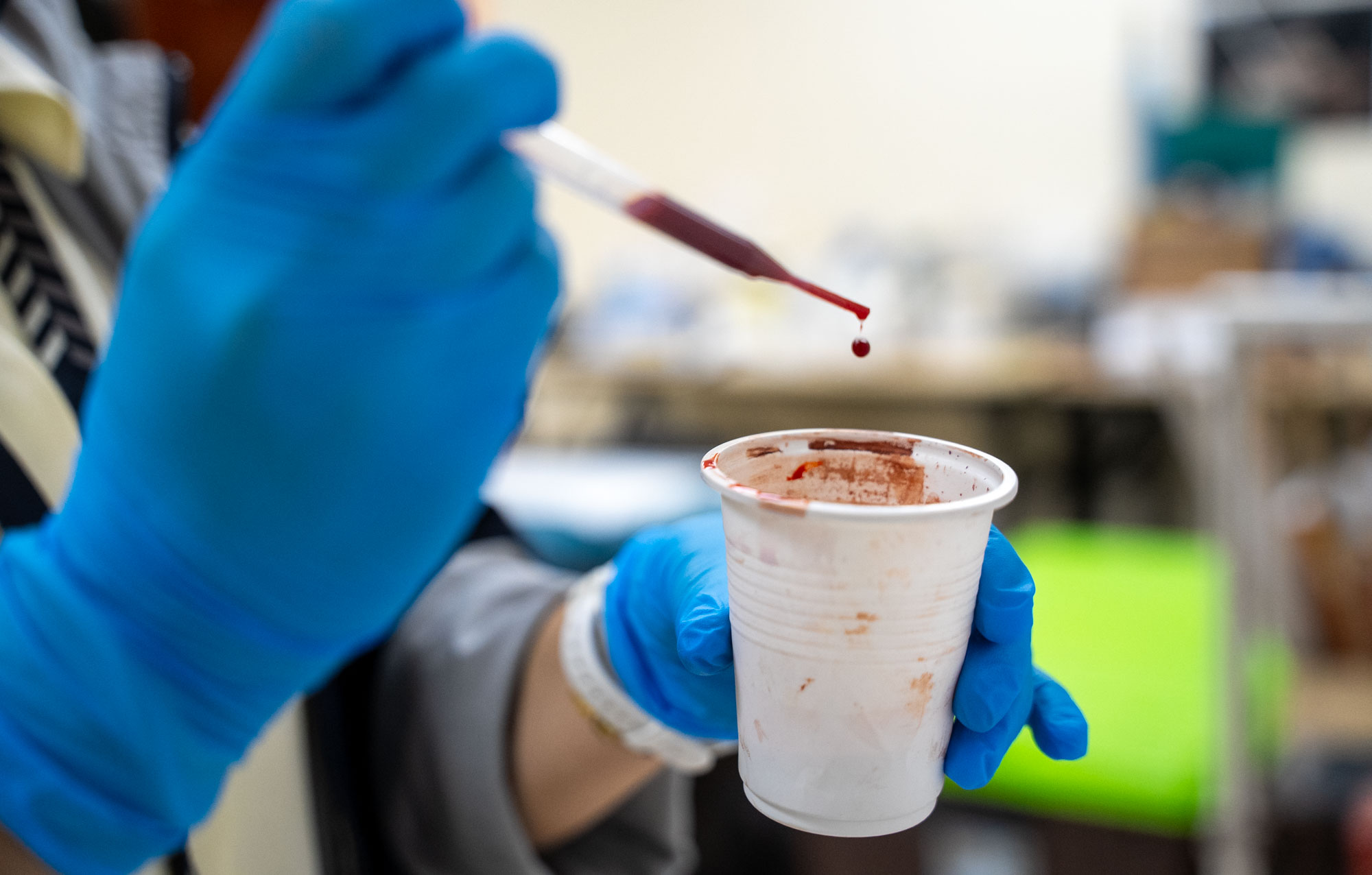
Weiwei emphasised that BPA does not work in isolation. It’s one pillar of what goes into an investigation report, which is complemented by other forensic areas such as autopsy findings, DNA analysis and others.
Having started taking advanced courses in BPA since 2019, she sometimes reexamines crime scene photographs from the past to apply her knowledge on a deeper level.
“Before, I mainly focused on DNA to figure out who a blood sample might belong to,” she said. “Now, by looking at different bloodstain patterns, I can also gauge how long the person was at the crime scene and if it was an active source of blood rather than just a deposition from another object.”
One of the most complex cases Weiwei worked on was a murder case involving an elderly couple in 2017. This was the first case where she saw two dead bodies at a scene. It was also a case of unnatural death with violence involved, so there were many bloodstains to mark out.
“This made it harder for me to know what to focus on first,” she shared. “After we had completed processing the scene, we also assisted with the post-mortem examination at the mortuary.”
Ultimately, Weiwei’s efforts helped officers link the accused, a foreign domestic helper, to the crime. Forensics confirmed that the helper’s fingerprint, which was found on a basin in the victim’s flat, was stained with blood from one of the victims. The offender was later arrested and sentenced.
“It was extremely satisfying to have played a part in solving this crime,” said Weiwei.
Steady Hands, Steely Nerves
I found it surprising that the violence and challenges of the job did not seem to faze her.
Said Weiwei: “We cannot allow our emotions to get in the way. As Crime Scene Specialists, we process the evidence at a scene rather than engage with the people affected by the crime. Maintaining this perspective allows us to approach each scene with focus, composure and observation to detail.”
On the scene, Weiwei directs all her attention on the extent of the bloodstains and what chemicals she has to use to enhance them as evidence.
But once she goes home, she doesn’t carry these images with her.
Ms Zhang reflected that it is easier for her to deal with the aftermath rather than when an incident is happening. “I’d panic and not know what to do if someone suddenly fainted in front of me,” she said. “But if I’m collecting evidence from a dead victim, I’ll be very calm because that’s what my job involves.”
Things were much different earlier in her career, when she’d mentally prepare herself “for the worst” by watching violent scenes in movies. “I had to tell myself that this is how it looks and it will not be any worse,” she recalled.
A Lifelong Calling
Where does Weiwei’s passion for forensic science stem from? It all started with a Hong Kong drama series called Forensic Heroes that she watched as a child.
Seeing the team of forensics officers at work, she admired the main character’s intelligence and aspired to have the same knowledge as him.
Then, in secondary school, Weiwei received from her teacher a brochure about Ngee Ann Polytechnic’s newly launched forensic science module and biomedical science diploma programme. She immediately knew this was her calling.
Weiwei joined the SPF after graduating in 2014 and never looked back. “Although I have to admit that working life is quite different from the drama series I used to watch,” she said with a smile.

Despite her challenging work demands, she relishes every new day at work. “Solving a crime is like fitting the final piece of a puzzle,” she said. “You help officers see a case more clearly because the evidence doesn’t lie – people do. Physical evidence is more objective and reliable because it can be verified; you can’t deny it.”
When I asked her what it takes to become an effective Crime Scene Specialist, she replied that integrity and open-mindedness are the most important traits.
“The outcome of a crime might not be what people expect,” she said. "You must be objective and say what the evidence is telling you.”
This commitment to the truth is what drives Weiwei daily. She keeps a folder called “Motivation” where she archives reports showing how key evidence linked suspects to their crimes, to remind herself of these small wins.
“These are the things that keep me going,” she said. “They tell me that I’m doing my part in providing justice to victims of crime.”


